


Introduction
Over the past decade, the way businesses operate has changed dramatically. Employees now work from home, data lives in the cloud, and applications are accessed from almost anywhere. While this flexibility has boosted productivity, it has also created new security challenges.
- Introduction
- Understanding SASE and Its Core Concept
- Why Businesses Are Driving the Rise of SASE
- Key Components of the SASE Architecture
- Benefits of Implementing SASE in Organisations
- SASE vs Traditional Network Security
- Challenges Businesses Face When Adopting SASE
- Practical Steps for Implementing SASE
- Technologies Behind the Rise of SASE
- Industries Benefiting Most from SASE
- The Future Outlook for SASE Technology
- FAQs About SASE
- Conclusion
Traditional network security models were designed for offices with centralised systems. Once companies began shifting to cloud services and remote work, those older systems started showing their age. Suddenly, organisations needed a smarter way to secure networks without slowing everything down.
That’s exactly where the rise of sase enters the conversation. SASE short for Secure Access Service Edge combines networking and security into a cloud-based architecture. Instead of protecting a single office network, it protects users, devices, and data wherever they happen to be.
Understanding SASE and Its Core Concept
Secure Access Service Edge, commonly known as SASE, is a modern framework that integrates networking services with advanced security tools. Rather than relying on physical appliances located in company offices, SASE delivers protection through cloud-based platforms.
The core idea behind SASE is simple: security should follow the user, not the location. Employees might connect from a home office, café, airport, or corporate building, yet their data still needs the same level of protection.
By combining networking capabilities like SD-WAN with security features such as secure web gateways and zero trust access, SASE creates a unified system. This approach allows organisations to maintain strong security while keeping network performance fast and reliable.
Why Businesses Are Driving the Rise of SASE
Modern businesses are constantly adapting to digital transformation. Cloud computing, mobile workforces, and remote collaboration tools have become everyday essentials rather than optional technologies.
These changes have forced organisations to rethink how they manage cybersecurity. Instead of protecting a central network hub, companies must secure thousands of distributed endpoints, including laptops, smartphones, and IoT devices.
As a result, the rise of sase reflects a growing demand for flexible security systems that work across multiple environments. Companies want protection that scales easily and adapts quickly to evolving threats, and SASE provides exactly that.
Key Components of the SASE Architecture
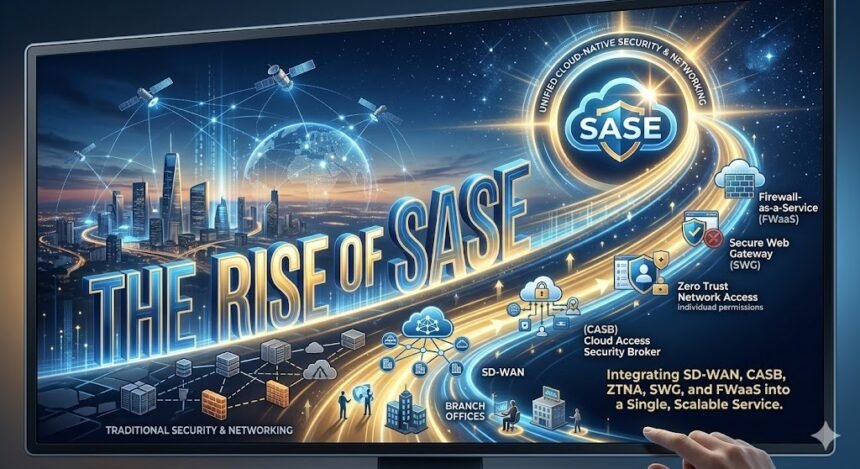
Before diving deeper, it helps to understand what technologies make up the SASE model. Rather than a single product, SASE is a combination of networking and security services working together.
These components form the foundation of a complete SASE framework:
- SD-WAN (Software-Defined Wide Area Network) for intelligent traffic routing
- Secure Web Gateway (SWG) for filtering malicious web activity
- Cloud Access Security Broker (CASB) for monitoring cloud services
- Zero Trust Network Access (ZTNA) to verify user identities
- Firewall as a Service (FWaaS) for cloud-based firewall protection
Benefits of Implementing SASE in Organisations
Companies adopting SASE often notice improvements in both security and performance. Because the architecture is cloud-based, it reduces the need for multiple on-site hardware appliances.
Another major advantage is simplified management. Instead of juggling several separate security tools, administrators can monitor policies through a single platform. This unified visibility makes detecting threats faster and responding to incidents easier.
Additionally, SASE improves the user experience. Employees connecting from different locations receive secure access without experiencing the delays often caused by traditional network routing methods.
SASE vs Traditional Network Security
| Feature | Traditional Security | SASE Architecture |
|---|---|---|
| Infrastructure | Hardware appliances | Cloud-based services |
| Security focus | Network perimeter | User and device identity |
| Scalability | Limited | Highly scalable |
| Remote access | Often slow | Optimised for remote work |
| Management | Multiple tools | Unified platform |
Challenges Businesses Face When Adopting SASE
Although the advantages are compelling, adopting SASE isn’t always a straightforward process. Organisations often face technical and strategic challenges during the transition.
One major hurdle involves integrating existing infrastructure with new cloud-based systems. Many companies still rely on legacy security tools, and migrating away from them requires careful planning.
Another challenge lies in organisational change. IT teams must learn new management platforms and security models, which can take time and training before everything runs smoothly.
Practical Steps for Implementing SASE
Adopting SASE successfully requires a thoughtful strategy. Jumping into new technology without planning rarely ends well, especially in cybersecurity.
To ensure a smoother transition, organisations often follow these steps:
- Evaluate existing network and security infrastructure
- Identify cloud applications and remote access requirements
- Choose a reliable SASE provider
- Gradually migrate security functions to the cloud
- Train IT teams on the new architecture
Technologies Behind the Rise of SASE
Zero Trust Security
Zero trust ensures that every user and device must be verified before gaining access to company resources.
Cloud-Native Networking
Cloud-native systems allow organisations to scale network services quickly without installing new hardware.
AI-Powered Threat Detection
Advanced analytics help identify suspicious activity and potential cyberattacks in real time.
Industries Benefiting Most from SASE
Several industries are experiencing significant advantages from adopting SASE architecture. These sectors often deal with sensitive data and distributed workforces, making modern security solutions especially valuable.
Technology companies, for example, frequently rely on cloud infrastructure and remote development teams. SASE helps maintain secure access while ensuring developers can collaborate efficiently from different locations.
Healthcare organisations are also embracing SASE because patient data must remain protected at all times. With staff accessing records across hospitals, clinics, and remote systems, a flexible security model becomes essential.
The Future Outlook for SASE Technology
Looking ahead, experts expect the popularity of SASE to continue growing. As organisations rely more heavily on cloud computing, the demand for integrated networking and security services will only increase.
Emerging technologies such as artificial intelligence and automation will likely enhance SASE platforms further. These innovations can help detect threats faster and adjust security policies automatically based on network behaviour.
Ultimately, the rise of sase reflects a broader shift toward cloud-native cybersecurity. Businesses are moving away from rigid systems and embracing flexible architectures designed for modern digital environments.
FAQs About SASE
What does SASE stand for?
SASE stands for Secure Access Service Edge, a cloud-based networking and security framework.
Why is SASE becoming popular?
It offers scalable security that works effectively for cloud environments and remote workforces.
Is SASE only for large companies?
No, businesses of all sizes can benefit from its flexible architecture and unified security model.
Does SASE replace traditional firewalls?
In many cases, it replaces hardware firewalls with cloud-based firewall services.
Is SASE difficult to implement?
Implementation can require planning, but many organisations adopt it gradually to simplify the transition.
Conclusion
The rapid shift toward cloud computing and remote work has reshaped how organisations approach cybersecurity. Instead of protecting a single network perimeter, businesses now need systems that secure users and data wherever they operate. That’s why the rise of sase has become such an important development in modern IT infrastructure. By combining networking and security into a unified cloud platform, SASE offers flexibility, scalability, and stronger protection. As digital transformation continues, more companies are likely to embrace this innovative approach. In many ways, SASE isn’t just a trend it’s a glimpse into the future of network security.